

Medically reviewed by Dr. Anil Agarwal, Fetal Medicine Specialist, Lotus Diagnostic Centre
Understanding X-rays, ultrasound, ECG, echocardiography, mammography, and other imaging methods
What Is Non-Invasive Diagnostic Imaging?
Non-invasive diagnostic imaging refers to techniques that allow doctors to see inside your body without making incisions, inserting instruments, or breaking the skin. These methods use various forms of energy — sound waves, electromagnetic radiation, magnetic fields, or electrical signals — to create detailed images of your internal organs, bones, blood vessels, and tissues.
The development of non-invasive imaging has been one of the most important advances in modern medicine. Before these technologies existed, diagnosing many internal conditions required exploratory surgery. Today, a doctor can detect a heart valve problem with an echocardiogram, identify a kidney stone with an ultrasound, spot a fracture with an X-ray, or monitor a growing baby with a pregnancy scan — all painlessly and within minutes.
Types of Non-Invasive Imaging
X-Ray Imaging
X-rays are the oldest and most widely used form of medical imaging. They work by passing a controlled beam of radiation through the body, which is absorbed differently by different tissues. Dense tissues like bone absorb more radiation and appear white on the image, while soft tissues appear in shades of grey and air appears black.
Common applications include detecting fractures, evaluating lung conditions (chest X-ray), assessing joint health, identifying kidney stones (KUB X-ray), and examining the spine. Digital X-rays, which are used at Lotus Diagnostic, produce clearer images with lower radiation doses compared to traditional film X-rays.
X-ray procedures are quick, typically taking just 5 to 15 minutes. No special preparation is usually required, though you will be asked to remove jewellery and metallic objects from the area being imaged.
Ultrasound (Sonography)
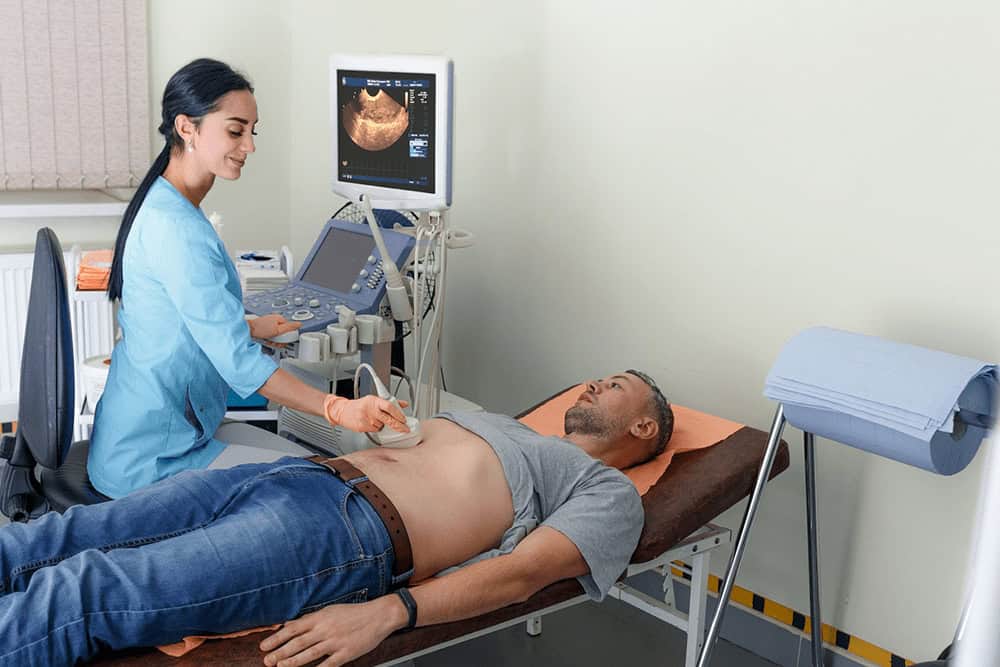
Ultrasound uses high-frequency sound waves to produce real-time images of soft tissues and organs. It is completely radiation-free, making it safe for all patients including pregnant women and children.
It is the preferred imaging method for examining abdominal organs (liver, gallbladder, kidneys, pancreas, spleen), the reproductive system, thyroid gland, breast tissue, and developing fetuses during pregnancy. Specialised forms like Doppler ultrasound can visualise blood flow through vessels, helping detect clots, blockages, or abnormal circulation.
Electrocardiogram (ECG)
An ECG records the electrical activity of your heart through small electrodes placed on your skin. It is a quick, painless test that takes about 5 to 10 minutes and provides immediate results.
ECG can detect irregular heart rhythms (arrhythmias), evidence of previous heart attacks, heart muscle thickening, and other cardiac electrical abnormalities. It is routinely included in comprehensive health checkups and is essential before any surgical procedure.
2D Echocardiography (Echo)
An echocardiogram is essentially an ultrasound of the heart. It produces detailed, moving images of your heart’s chambers, valves, walls, and blood vessels. It shows how well your heart is pumping, whether the valves are opening and closing properly, and whether there are any structural abnormalities.
Echo is used to evaluate heart murmurs, assess heart function after a heart attack, monitor heart failure, evaluate chest pain, and screen for heart disease in high-risk individuals. The procedure takes 20 to 40 minutes and requires no special preparation.
Mammography
Mammography is a specialised X-ray imaging technique used specifically for breast tissue. It can detect breast cancer at very early stages — often years before a lump can be felt by hand. Digital mammography produces detailed images of breast tissue that allow radiologists to identify calcifications, masses, and other abnormalities.
Guidelines generally recommend that women begin regular mammography screening from age 40, or earlier if there is a strong family history of breast cancer. At Lotus Diagnostic, bilateral mammography (both breasts) is available at both our centres.
DEXA Scan (Bone Densitometry)
A DEXA (Dual-Energy X-ray Absorptiometry) scan measures bone mineral density to diagnose osteoporosis or assess your risk of developing it. It uses a very low dose of radiation — less than a standard chest X-ray — to scan specific areas, usually the spine, hip, or wrist.
DEXA scans are particularly important for postmenopausal women, older adults, people with a family history of osteoporosis, and anyone with conditions or medications that affect bone health (such as long-term corticosteroid use). Early detection of low bone density allows treatment to begin before fractures occur.
Treadmill Test (TMT)
A treadmill test, also called a cardiac stress test or exercise stress test, monitors your heart’s response to physical exertion. You walk on a treadmill at increasing speeds and inclines while an ECG continuously records your heart’s electrical activity.
The test helps detect coronary artery disease by revealing areas of the heart that do not receive adequate blood flow during exercise. It is commonly recommended for people with chest pain, shortness of breath during exertion, or risk factors for heart disease.
Benefits of Non-Invasive Imaging
No pain or discomfort: Unlike invasive procedures, these tests cause no pain and require no anaesthesia or recovery time.
Rapid results: Most imaging results are available the same day, allowing doctors to make timely treatment decisions.
Early detection: Imaging can detect conditions before symptoms appear, enabling earlier and more effective treatment.
Lower cost: Non-invasive imaging is significantly less expensive than surgical exploration or invasive diagnostic procedures.
Safety: Modern imaging uses minimal radiation (X-ray, DEXA) or none at all (ultrasound, ECG, echo), making repeat testing safe.
Non-Invasive Imaging at Lotus Diagnostic
Lotus Diagnostic Centre offers a complete range of non-invasive imaging services at our NABL-accredited facilities in Koramangala and Indiranagar, Bangalore. Our imaging department is equipped with modern digital equipment and staffed by experienced radiologists and cardiologists.
Available imaging services: Digital X-ray, ultrasound (all types including obstetric, abdominal, pelvic, thyroid, breast), ECG, 2D echocardiography, Doppler studies, mammography, DEXA scan (bone density), treadmill test (TMT), and pulmonary function test (PFT).
X-ray services are available on a walk-in basis. For ultrasound scans, we operate on a first-come-first-serve token system. ECG, echo, and TMT may require prior scheduling depending on doctor availability.
About the Medical Reviewer
Dr. Anil Agarwal is a Fetal Medicine Specialist and Radiologist with 35+ years of experience at Lotus Diagnostic Centre, Bangalore. His qualifications include MBBS, RDMS (USA).
Book your imaging appointment at lotusdiagnostic.com or call 9099390993. Walk-ins welcome for X-ray. Koramangala: 18th Main, 6th Block. Indiranagar: CMH Road.
Frequently Asked Questions
Is radiation from X-rays dangerous?
The radiation dose from a single diagnostic X-ray is very small and considered safe. Digital X-rays, which are used at Lotus Diagnostic, use even lower doses than traditional film X-rays. However, X-rays are generally avoided during pregnancy unless absolutely necessary.
How is an ultrasound different from an X-ray?
X-rays are best for imaging bones and detecting conditions like fractures, lung infections, and kidney stones. Ultrasound is better for soft tissue organs like the liver, kidneys, uterus, and developing babies. Ultrasound uses sound waves (no radiation), while X-rays use a controlled beam of radiation.
Do I need a doctor’s referral for imaging tests?
A referral is recommended to ensure the correct test is performed. For X-rays and basic ultrasounds, you can often walk in or call to check availability. For specialised scans, having a doctor’s prescription helps our team tailor the examination to your specific clinical question.
How long do imaging tests take?
Most imaging tests are quick: X-rays take 5 to 15 minutes, ECG takes 5 to 10 minutes, ultrasound takes 15 to 30 minutes, echo takes 20 to 40 minutes, and a treadmill test takes 15 to 30 minutes. DEXA scans typically take about 10 to 15 minutes.